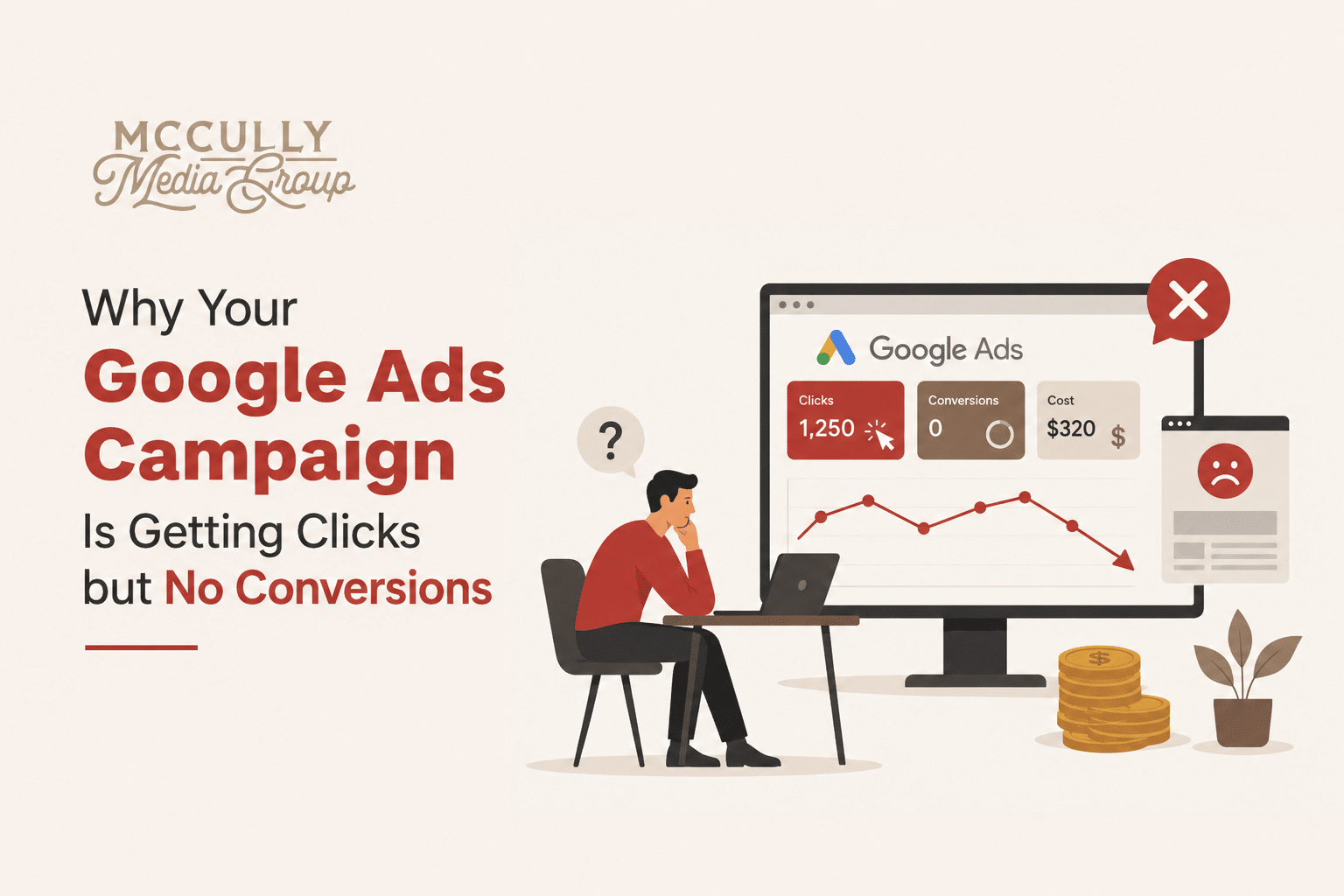

You check your Google Ads dashboard, and the numbers look promising. Clicks are coming in. People are seeing your ads and clicking through. But when you look at actual results, the phones aren’t ringing, the forms aren’t being filled out, and new appointments aren’t showing up on the calendar.
If your Google Ads campaign is generating clicks but not converting those clicks into real leads, you’re not alone. This is one of the most common (and most frustrating) problems business owners face when running paid search campaigns. The good news is that a click-but-no-conversion problem almost always has a fixable cause.
Here’s what’s likely happening and what you can do about it.
Your Landing Page Isn’t Built to Convert
This is the number one reason Google Ads campaigns fail to produce leads. Your ad does its job by getting someone to click. But the page they land on doesn’t finish the job.
Think about what happens when a potential customer clicks your ad. They’re looking for a specific solution. If your landing page is cluttered, confusing, or doesn’t clearly explain how you solve their problem, they leave. It doesn’t matter how good your ad copy is if the page behind it doesn’t deliver.
A landing page that converts has a few essential elements:
- A clear headline that matches the promise of your ad
- A simple explanation of what you do and who you help
- An obvious next step, whether that’s calling, filling out a form, or booking an appointment
- Fast load time, especially on mobile devices
Your website design plays a direct role in whether your Google Ads generate leads or waste your budget. If your site doesn’t pass what StoryBrand calls the “grunt test” (can a visitor understand what you offer within five seconds?), then even the best-targeted ads won’t convert.
You’re Targeting the Wrong Keywords
Not every click is equally valuable. If your Google Ads campaign is targeting broad or irrelevant keywords, you might be paying for clicks from people who were never going to become customers.
For example, a plumbing company running ads on the keyword “plumbing” will get clicks from people researching plumbing careers, looking for DIY tutorials, or searching for plumbing supply stores. None of those people need to hire a plumber.
The fix is tighter keyword targeting. Focus on keywords that signal buying intent, phrases like “emergency plumber near me” or “plumber in Fort Worth” rather than broad, informational terms. Use negative keywords to filter out searches that don’t match what you offer. And review your search terms report regularly to see exactly what queries are triggering your ads.
This kind of strategic Google Ads management is what separates campaigns that generate real leads from campaigns that just burn through budget.
Your Ad Copy Doesn’t Match the Landing Page
When someone clicks your ad, they have a specific expectation. If your ad says “Free Roof Inspection in Fort Worth” but the landing page talks about your company’s history and a list of every service you offer, there’s a disconnect. That disconnect kills conversions.
Your ad and your landing page need to tell the same story. The headline, the offer, and the call to action should all align. When a visitor feels like they’ve landed in the right place, they’re far more likely to take the next step.
This is also where many business owners accidentally send paid traffic to their homepage. Your homepage serves a different purpose than a dedicated landing page. It’s designed for general visitors, not for someone who just clicked an ad about a specific service. Build landing pages that match your ads one to one, and you’ll see conversion rates improve.
Your Call to Action Is Weak or Missing
You’d be surprised how often this is the problem. A business owner runs a solid Google Ads campaign with relevant keywords and decent ad copy, but the landing page buries the call to action at the bottom of the page or makes it vague.
“Contact us” is not a strong call to action. “Learn more” doesn’t tell anyone what happens next.
Your CTA should make the next step crystal clear and low-pressure. Something like “Schedule a Free Estimate” or “Book Your Appointment Today” tells the visitor exactly what they’re getting and removes friction from the process.
Make sure your CTA is visible without scrolling, especially on mobile. Include your phone number where people can see it. And if you’re using a form, keep it short. Name, phone, and a brief description of what they need. That’s usually enough to start the conversation.
You’re Not Tracking Conversions Correctly
Here’s a scenario that happens more often than you’d think: your Google Ads are actually working, but your tracking isn’t set up properly, so the conversions aren’t being recorded.
If you haven’t configured conversion tracking in Google Ads (phone calls, form submissions, appointment bookings), you’re flying blind. You can’t optimize a campaign if you don’t know which ads, keywords, and landing pages are producing results.
At a minimum, you should be tracking:
- Phone calls from your ads and landing pages
- Form submissions
- Click-to-call actions on mobile
- Any booking or scheduling confirmations
Without this data, you can’t tell the difference between a campaign that’s failing and one that’s succeeding but not being measured. Proper tracking is the foundation of any ad campaign that improves over time.
You’re Competing on Price Instead of Value
Some business owners try to win clicks by advertising the lowest price. But when your entire ad strategy is built around being the cheapest option, you attract price shoppers who are less likely to convert into loyal customers.
Instead, focus your ads on the value you provide. What makes your business different? What problem do you solve better than anyone else? For service-based businesses in Fort Worth, that might mean highlighting your response time, your expertise, your warranty, or your customer reviews.
When your ads attract people who are looking for quality and trust rather than just the lowest bid, your conversion rate goes up and your customer lifetime value goes up with it.
What to Do If Your Google Ads Aren’t Converting
If you’re spending money on Google Ads and not seeing the leads you expected, don’t just throw more money at the problem. Step back and look at the full picture.
Start by auditing your landing pages. Are they clear, fast, and focused on a single service or offer? Then review your keyword targeting. Are you reaching people who are ready to hire, or are you paying for clicks from people who are just browsing?
Check your conversion tracking. Make sure every phone call, form fill, and booking is being counted. And look at the alignment between your ads and your landing pages. If there’s a gap between what the ad promises and what the page delivers, close it.
Google Ads can be one of the most effective tools for generating leads for your business. But only when every piece of the campaign, from keyword selection to ad copy to landing page design to SEO strategy, is working together toward one goal: turning a click into a customer.
Get Google Ads That Actually Generate Leads
McCully Media Group is a Fort Worth digital marketing agency that helps service-based businesses turn their marketing into real results: more calls, more form fills, and more booked appointments. Our StoryBrand-certified team builds Google Ads campaigns designed to convert, backed by landing pages and content strategies that keep your pipeline full.
If your ads are getting clicks but not conversions, let’s figure out why and fix it.